Humble Crumble

The soon to be legendary Mrs. Patmore, from the mega hit TV series on PBS, Downton Abbey, is the head cook brimming with one liners that can only be heard from downstairs within the heat of the kitchen and in this case, the heat, directed to her assistant, Daisy, the scullery maid.

Mrs. Patmore: Daisy, I said you could go for a drink of water, not a trip up the Nile.

Mrs. Patmore: Listen to me Daisy, take those kidneys up to the servery before I knock you down and serve your brains as fritters.

Daisy:  I was only trying to help.

Mrs. Patmore:  Oh!…Judus was only trying to help, I suppose, when he brought the Roman Soldiers to the Garden. 

So what's a scullery-maid?—from Mrs. Beeton's The Book of Household Management - circa 1861

The duties of the scullery-maid are to assist the cook; to keep the scullery clean, and all the metallic as well as earthenware kitchen utensils. The position of scullery-maid is not, of course, one of high rank, nor is the payment for her services large. But if she be fortunate enough to have over her a good kitchen-maid and clever cook, she may very soon learn to perform various little duties connected with cooking operations, which may be of considerable service in fitting her for a more responsible place.
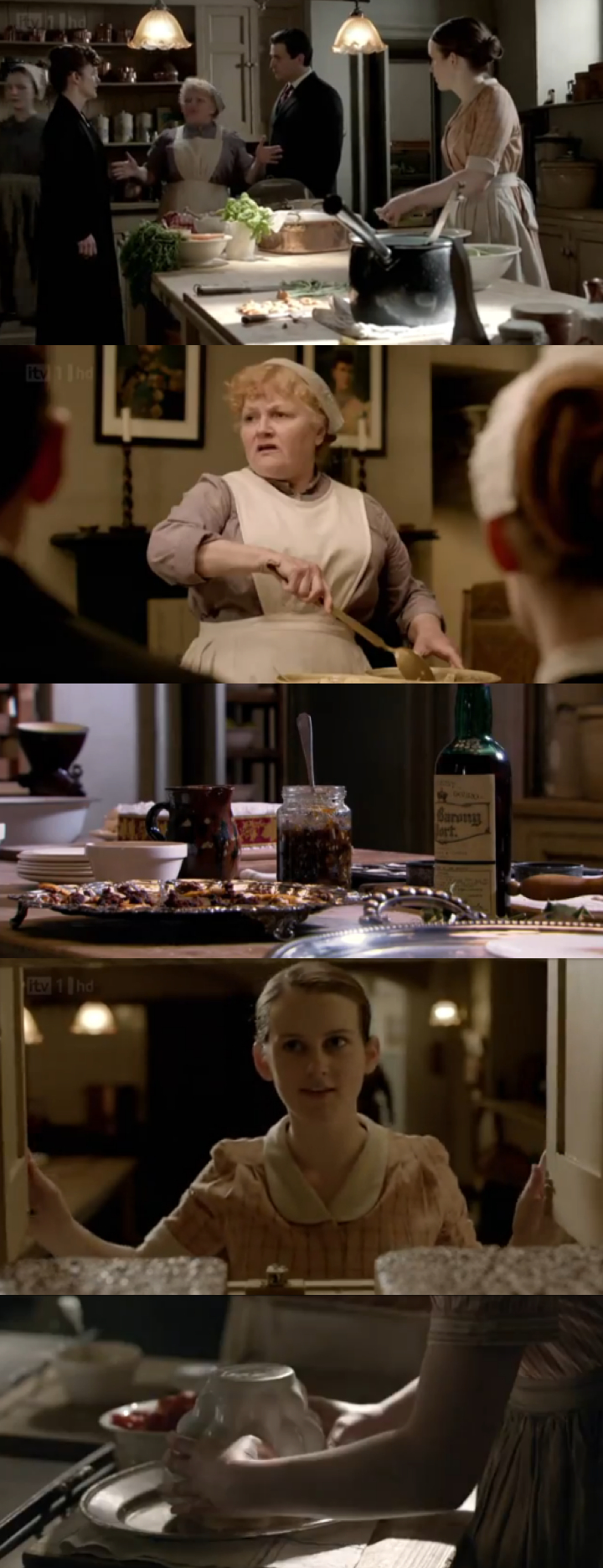
While Mrs. Patmore is taking a well deserved rest, in one scene, Daisy interrupts Mrs. Patmore in the servant’s hall unsure if the crumble was ready. Sorry, you will just need to watch this weeks finale of season 2 Downton Abbey for more of Mrs. Patmore good hearted but sometimes cutting humor. 

Meanwhile, enjoy My Apple Charlotte Recipe, a dish Mrs. Patmore was not able to plate-up, reason, you'll need to watch-n-see (don't want to spoil the plot).

Another dessert dish, circa 1915 featured on Downton Abbey - "Humble Crumble":

Crumbles can be traced back to the UK, but became highly popular in America during colonization, where it is also known as a crisp.  The crumble originated as a wartime dessert due to strict rationing.  The crumb topping, or cumble is a mix of flour, butter and sugar and replaced pastry or typical pie crusts. Fruits such as apples, blackberry, and rhubarb are often used depending on seasons or what was previously preserved and on hand.  

TIPS: picking the right apple
Granny: This Australian native was discovered in 1868 as a chance seedling by "Granny" Anne Smith of Ryde, New South Wales. One parent might have been a French Crab Apple. Grannys are known for their distinctive green flesh, which sometimes bears a red blush, and their very tart flavor. An all-purpose apple, Grannys work equally well as a snack or in pies and sauce. U.S. Grannys are harvested beginning in August, and are available year-round.

Gala: This variety originated in New Zealand, a cross between Kidd's Orange Red and Golden Delicious. The Royal Gala strain was named in honor of Queen Elizabeth II, who deemed it her favorite during a visit to New Zealand. It was brought to the United States in the early 1970s, and is now one of the country's most popular apples. This crispy, juicy, very sweet apple is ideal for snacking. Galas can vary in color, from cream to red- and yellow-striped. U.S.-grown Galas are harvested beginning in mid-July, and are typically available year-round.
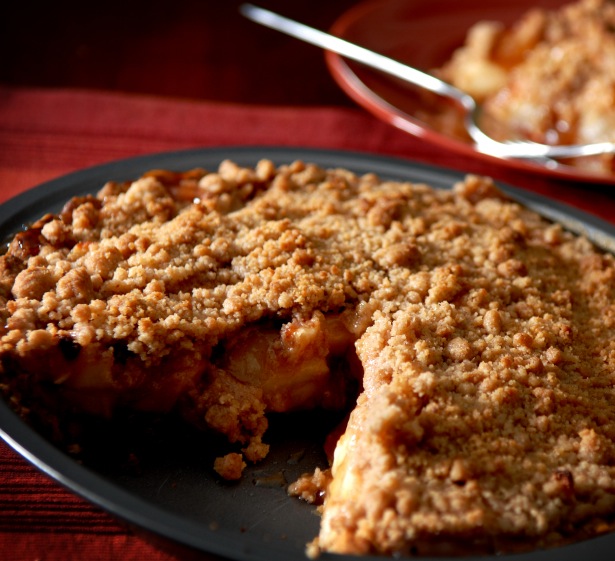
George’s Warm Apple Crumble Recipe
Makes 4–6 servings
As seen on George Hirsch Living it UP! TV series

For Topping:
1/3 cup brown sugar
1/3 cup granulated sugar
1/4 cup flour
3/4 quick oats
1/4 cup chopped pecans or walnuts
1/2 cup melted butter 

Mix all sugars, flour, oats and nuts. Pour in butter and mix until topping looks like wet sand. Do not over mix; topping should have a lumpy consistency.

For the Filling:
4 cups Apples- 1/2 granny and 1/2 gala or other sweet apple, peeled, cored and chopped into 1/2 inch pieces. 
1/3 cup water or *simple syrup
1/4 cup raisins, plump in simple syrup

Pre heat a 375 degree oven.

Grease small individual ramekins or one nine inch ovenproof casserole. Add chopped apples, raisins and simple syrup. Top with a generous amount of crumb topping.  Bake for 35 to 45 minutes or until crumb topping is crisp and light brown. 

Serve warm topped with powder sugar, whip cream or powder sugar.

*To make simple syrup:
1 cup water
2 cups sugar
1 orange, cut into quarters

Place all ingredients into a saucepan. Bring to a boil and cook for five minutes. Remove and cool.
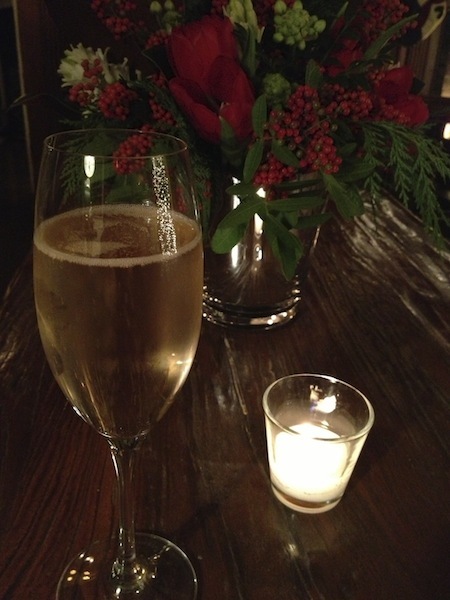
King of Cocktails

Champagne is recognized as the universal symbol of good news, and this cocktail's simple recipe shows that life doesn't have to be complicated to be enjoyed. A classic Champagne Cocktail may not be a trendy drink these days, but as a classic, it’s as good as when Cary Grant and Deborah Kerr sipped it in An Affair To Remember. 

A great Champagne stands on its own and should be sipped solo, whereas an inexpensive sparkling wine benefits from the bitters and the sugar cube keeps those bubbles hopping. 

Classic Champagne Cocktail Recipe: Six ounces of Champagne or sparkling wine and a sugar cube soaked in Angostura bitters is all it takes to make a sophisticated cocktail for the New Year. Drop the sugar cube into a tall flute glass, and then slowly add champagne and a lemon twist. 

Tips: With the Champagne Cocktail, you can trust the bitters to take the edge off a lesser quality champagne or sparkling wine. For this drink, you can use a less expensive wine, spending about $10 to $18 for a good domestic bottle. Or, as I personally prefer to use a good Prosecco for under $15.

When opening Champagne or Prosecco, use a gentle twist - save the bubbles for the inside of the glass and not the floor.

Optional: If bitters in sparkling wine is not your cup of tea, a Prosecco Spritzer Cocktail could be the toast for you. To a glass of prosecco, omit bitters, sugar and lemon and replace with splash of limoncello and Cognac and go all Amalifi-like. Cin cin!


chefgeorgehirsch.com

New Years Eve, Cotechino Con Lenticchie

In Italy, people welcome the New Year by tossing old things out of their windows to make room for the new and bring luck into their lives in the upcoming year. In regards to food traditions, Italians cook up a dish called Cotechino Con Lenticchie, pork sausage served over lentils. This dish is eaten during the New Year because of the presence of a rich and robust pork sausage with lentils in the dish. Cotechino sausage is a symbol of abundance because it is rich in fat; while the coin-shaped lentils symbolize money. 

I love it served with a steamy dish of gnocchi and sautéed garlicky greens, another symbol of prosperity. 

Cotechino Con Lenticchie: Pork Sausage Served over Lentils

by George Hirsch | Makes six servings

chefgeorgehirsch.com

If you can't find cotechino, a high quality fresh pork sausage flavored with nutmeg, and pepper a good hearty italian style sausage will suffice. 

1 pound cotechino, pork sausage
1 Tablespoon olive oil
1 onion, chopped
4 cloves garlic
1 large carrot, chopped
1 bay leaf
8 whole black peppercorns
1 sprig fresh thyme 
1 pound dry green lentils
4 cups chicken broth
1 bunch fresh parsley, chopped 

Pierce the cotechino with a fork in several places. 

Pre heat a large pot and add olive oil, chopped onion, garlic, carrot, 1 bay leaf, peppercorns and thyme. Simmer vegetables for two minutes and add cotechino, cook two minutes and add lentils, cover with 4 cups broth and bring to a boil. Reduce heat to low and let simmer for 45 to 50 minutes or until lentils are soft. Add additional water if necessary. 

Remove the bay leaf and discard. Spoon the lentils into a serving dish, drizzle with olive oil and slice rounds of the cotechino over the top. Sprinkle with fresh chopped parsley and serve. 

Holiday, The Seven Fishes

Join me + Tune-in / dvr George Hirsch Lifestyle CreateTV New Year’s Celebration Marathon Sat Dec 28th 9AM/9PM & Sun Dec 29th 3PM

+ Check local listings for the new season of GHL Celebrating Chef George's 25th anniversary on PBS and Public TV Stations. Click to watch TV Series Preview

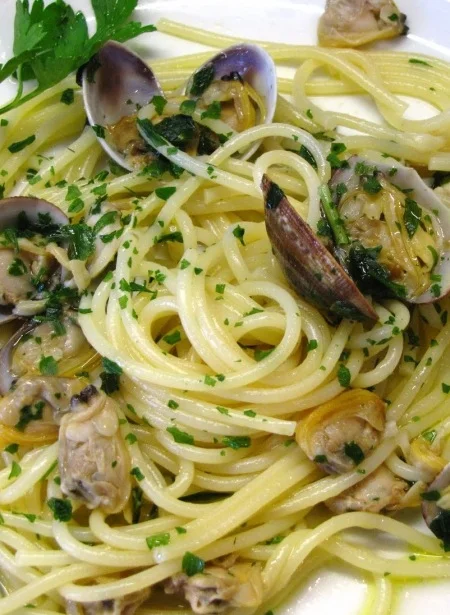
George_Hirsch_Linguni_Clams.jpeg

A popular southern Italian tradition celebrated all over the world, is the Feast of the Seven Fishes. In Italy it is called “la cena della vigilia,” or Christmas Eve Dinner, December 24th; observed by abstaining from eating meat on Christmas Eve and enjoying the holiday meal with family, filled with a seafood spread.

WHY SEVEN?:

Some say the number seven represents the seven sacraments, seven days of creation, or simply the fact that seven signifies

perfection

in the Bible. This may be speculation, however what is known is that this celebration is something that is very much appreciated and shared by most Italians and lovers of fish.

Fish:

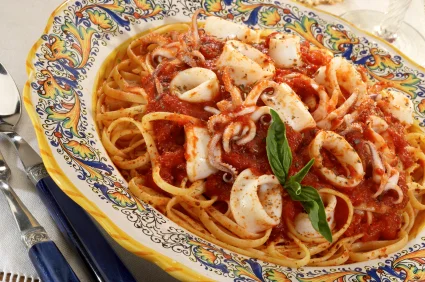
You will find virtually any Mediterranean fish prepared from this region. Everything from anchovies to eel. Popular fishes in the feast include calamari, smelts, clams, and shrimp. 

One of my favorite is baccalá, a dried, salted cod. 

Baccala How To:

To reconstitute the baccalá, you soak it for two days, changing the water three or four times.

I prepare the baccalá several ways including sauted and with tomatoes, but it's also quite popular to prepare it in the oven with potatoes or even in a salad with potatoes and black olives.

The Seven Fishes is a feast that brings family and friends together to celebrate a very important evening, and the seafood is only the centerpiece of what really takes place... keeping a tradition alive with family and friends.

Isn’t this what holidays are really about?

Buone feste!

calamari-dailyfood.jpg

Mini Sausage & Artichoke Calzone

Calzone is a very popular side or main dish, so I have adapted it for appetizer bite-sized portions. It's very flexible; you can dress it up or down. You can give the piggy in the blanket the night off this holiday.

Calzone comes from the Italian word meaning “trouser leg” (plural: calzoni) but it looks more like a turnover. Calzone is made from pizza dough and stuffed with many toppings you would use on a pizza. As one story goes, peasants found it messy to carry pizza into the fields for lunch, so some enterprising cook came up with the idea of folding the pizza in half and cooking it that way.

Mini Sausage & Artichoke Calzone

From George Hirsch Living it UP! TV series | chefgeorgehirsch.com

Makes four-six hors d'oeuvre servings

one recipe, George's Pizza Dough (or store bought), divided into two pieces
2 Tablespoons olive oil
8 ounces fresh mozzarella, shredded
8 ounces Italian sausage, cooked & chopped
1/4 cup artichoke hearts - canned or frozen, chopped
2 Tablespoons Parmesan cheese
fresh ground black pepper

1 cup Tomato Sauce
Pre heat oven to 375 degrees.

Flatten out both pieces of dough into rectangle shapes.  Cut both pieces of dough into three to four pieces depending on how small you want to make your Calzone. A good rule to follow is to make them one bite size.  

Keeping filling off the edges, layer each piece of dough with a teaspoon of mozzarella, sausage, Parmesan cheese, artichokes, and black pepper. Brush inside edge of dough lightly with water.  Fold over the dough into a pocket and seal edges.  Pierce the dough with the point a small knife with three small holes to allow steam to escape.

Brush outside of Calzone with olive oil and place on a baking pan or pizza stone.  Calzones can also be baked on pre-heated bricks that are set in oven or on a medium temperature grill surface.  

The calzones will bake in about 10-12 minutes. 
To check doneness, the bottom of the calzone will have a hollow sound when tapped with your finger.

Serve tomato sauce on side.

Tip: Sausage and artichokes can be substituted with cooked spinach broccoli flowers, mushrooms, or ham and your imagination.