
The Fruit Whisperer

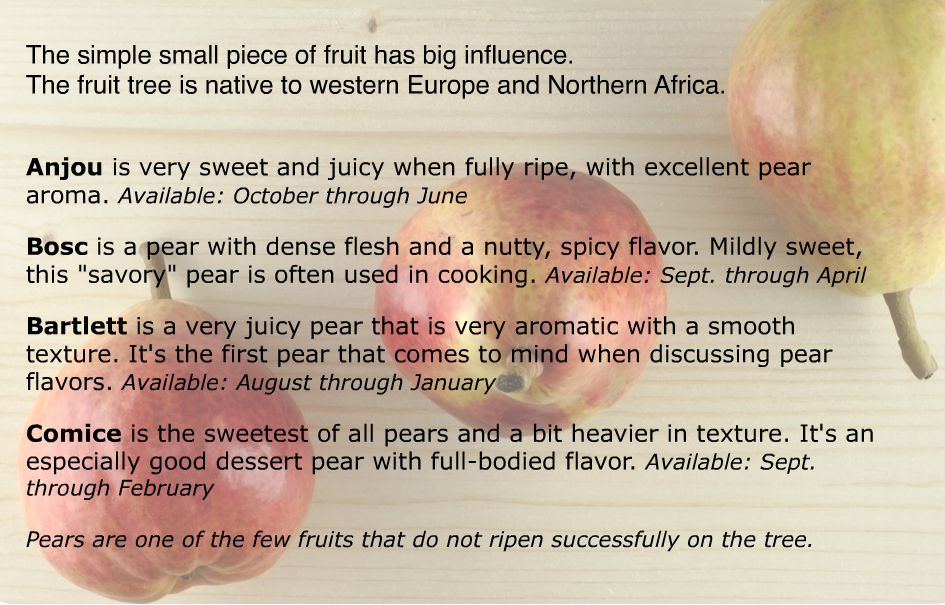
This is a serious topic at my house—knowing when to cut into a perfectly ripened piece of fruit. There is a fine line between unripened and overripe. Here are a few ideas that may help widen that window of use for your pears. Are you ever stuck, trying to make a different salad? Try slicing a ripe pear with feta or blue cheese. Has that pear on the counter over-ripened? Don't fret, chop it up and add it to a spicey soup or make a decandent dessert like my Roasted Pears with Raspberry Sauce which is ideal during the holiday season!
Roasted Pears and Raspberry Sauce
by George Hirsch | 4 Four Servings

4 ripe Bosc or Anjou pears
2 tablespoons melted butter or margarine
2 tablespoons cinnamon sugar
1 cup fresh or frozen raspberries
1 cup seedless raspberry preserves
2 Tablespoons orange juice
4 sprigs of fresh mint

Pre heat oven to 350 degrees.

Cut pears lengthwise into half, remove the cores.  Grease a non stick pan with butter.  Place quartered pears in pan and top with cinnamon sugar.  Cover pears and bake for 8-12 minutes or until slightly soft.  The time will vary according to level of ripeness.  Remove from oven and cool.

In a sauce pan simmer three fourths of the raspberries, the preserves, and orange juice for 4-5 minutes.  Press the sauce through a strainer, discarding the seeds.  

Pour the sauce evenly onto four dessert dishes, topping each with two pear halves.  Add the remaining raspberries on top of pears.  Top with fresh mint leaves.

Coffee, Beyond The Brew

I'm guessing, the first words of the day globally are- make coffee. Yet, to have a really good cup of coffee, is another thing. I’ve shared with you my favorite place in Italy for great espresso, and am still on my global quest for the best cup of regular coffee. Right now, brewed coffee in my kitchen is in first place. I’ve told you about my favorite coffee accoutrements, and now here's a handy checklist of tips to keep that first cup of the day - your best!

Suggestions for good tasting coffee
- Use good quality coffee, freshly roasted and freshly ground.
- Grind your own beans for the best tasting coffee, and only grind as much coffee as you will immediately use.
- Use the proper grind. If the brewing process is quick, the grind should be fine; if the process takes more time, the grind should be made more coarse.
- Use fresh, clean, cold water. Filtered or bottled water works well.
- Make only enough coffee for your immediate consumption.
- Coffee tastes best when it is fresh, best within 10 minutes. The longer it sits, the more bitter it gets. 

How-to clean your coffee maker once a month
- Remove filter from coffee maker.
- Fill carafe with cold water and add two tablespoons of white vinegar.
- Pour water and vinegar into the coffee maker and turn on the coffee maker.
- Let it brew halfway through the brewing cycle, stop machine for 10 minutes.
- Resume the brewing process and let the brewing cycle complete.
- Rinse carafe and brew two pots of plain water.
- Rinse carafe. It is now ready to brew with coffee.


The Ancient Art of Pu-Erh

How many times have you had dim sum and thought, "what kind of tea is that?" Nine times out of ten you were drinking pu-erh tea, which aids in the digestion of fried foods. 

Pu-erh Tea has more than 1,750 years of recorded history dating back to China’s Three Kingdoms Period.

The geographical origin of Pu-erh Tea is located in China’s Yunnan Province within the areas of the Lancang River Basin. This region of Southwestern Yunnan is home to the world’s oldest tea cultures and tea economy. The broad leaf tea tree species used to make authentic Pu-erh has been consumed as a food, medicine and beverage by Yunnan’s ancient inhabitants of Tibeto-Burman origin who are known as the “Pu” ethnic group and the world’s first tea farmers.

There are two main types of Pu-erh tea: “Green Pu-erh” more accurately described as “Semi-green tea” and “Black Pu-erh” more accurately described as “Dark Green Tea.” Both semi-green and dark green pu-erhs are made with “Saiqing” or “sun-dried green tea.” Authentic Pu-erh teas can only be made from Yunnan’s famous broad leaf arbor tea tree varietals.

According to Traditional Chinese Medicine, Pu-erh tea has a warming and potent digestive property. Chinese doctors consider Pu-erh as a tea that dispels or cleanses the body of fat and toxins from meat and oily foods. This is also why Pu-erh has such a wide appeal amongst many Asian food cultures. Recent research suggests that consuming 5-8 cups of Pu-erh Tea each day can reduce cholesterol and plaque of the arteries.

Rishi Tea is the first in the US to offer Certified Organic and Fair Trade Pu-erh Tea hand harvested from ancient tea trees.

 references, Rishi Tea Co.

Thanksgiving Leftovers

What to do with all that turkey? You gave goodie bags away, but there seems to be so much left, still. Well, here are a couple great ideas beyond the old turkey-n-gravy sandwich, which isn't that bad either.

My number one requested one-pot meal recipe is my White Turkey Chili; I prepared on Live with Regis & Kelly. It's so easy to prepare; just give all the ingredients time to simmer. Another favorite is my Turkey Gumbo; a spicy and a warm way to serve turkey. 

For a quick turkey snack, fix a Turkey NLT. That’s turkey on Naan bread; grilled with sliced vine tomatoes, lettuce and wasabi dressing.

White Turkey Chili

Turkey Gumbo

Turkey NLT

image, eatturkey.com